|
About the
Koto
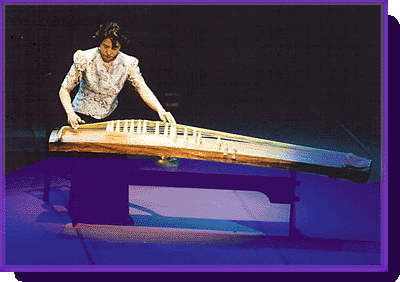
The koto (so)
is a string instrument that originated in China and came to Japan in the sixth century.
It is a long instrument, about six feet long, consisting of a hollow body made from paulownia wood and
the shape of the koto is imaged in the dragon (ryu). So the names of various parts of the koto
correspond to various parts of the dragon. For example, ryukaku (horn),
ryubi (tail), ryugan (eyes) etc.
There are 13strings which are tied over stationary bridges (kotoji ) at each end of the body.
The strings are tuned by sliding the movable bridges back and forth.
The koto came to Japan from China that was initially used only within the Imperial
Court,
however the Edo period the koto became popular among wealthy people as a sign of culture
for young girls and women.
Kengyo Yatsuhashi (1614-
1685 the one of the greatest composers
)
contributed to this new beginning
of the koto music. His one of the most famous music is “ Rokudan no Shirabe ”.
I think that playing technique of this music is not so difficult but there
are a few to play more
impressively .
In the early of 20th century, the appearance of Michio Miyagi
(
1894
-
1956
)
changed the
history of koto. He was born in Kobe and lived in the extraterritorial settlement of foreigners in
his childhood. At that time, Kobe was an international trading port like
an exotic city that i
influenced him to compose his koto music later.He absorbed European classic music interestingly.
His excellent sense mixed well classic and contemporary koto music without lose the quality of
koto. He composed music about 350 pecies.
Particularly “ The spring sea (Haru no Umi) ”
spread his name to the world with his incomparable performance.
Jushichi-gen (17stringed koto) invented by him for lower koto
.
He became blind when he was about 8. He had no choice to study the koto for living.
Studying harder than anyone else with his natural gift and love he became
a regent.
I have a great respect for him and love his music very much, but it is
difficult to play well
his exquisite and magnificent melody.
About me
I have been studying the koto over 45 years. I belong to the Seiha division of ikuta school.
I earned a junior master license that qualified me as a koto teacher when I was 19.
About 30 years later I raised the license to a grand master (the highest
qualification of Seiha
School).
And
I am learning it from Sumiko Goto (the one of the most famous and superior
performers in Japan. She visits many cities in the world as a member of
4nin no kai and gains
high reputation at every where) about 20 years.
She comes from Tokyo to teach students once a month gratefully. I learned a lot of valuable
things that she created. Her words are these, ‘use your brain ’‘do not
waste your time and
energy to move’ ‘ fly low and shortest ’‘ imagine pearls ! yours are lead’etc.
Recently I taught 15 beginners of junior high school students to perform
for their school
festival.They were able to play the koto music that was not so easy for beginners in less than
30 hours. They were amazing kids. They put my teachings (her words) into
practice obediently.
As the result of their effort, they played successfully on the festival
stage beyond my expectation
and my eyes were full.
Prizes
1975 The first prize winner (contemporary koto music) of Hokkaido Sankyoku (koto,
shamisen, shakuhachi) Competition.
1976 The first prize winner (classic koto music) of Hokkaido Sankyoku Competition.
1979 The grand prize winner (new performer of Japanese traditional music) of Sapporo
City Art Festival.
|